
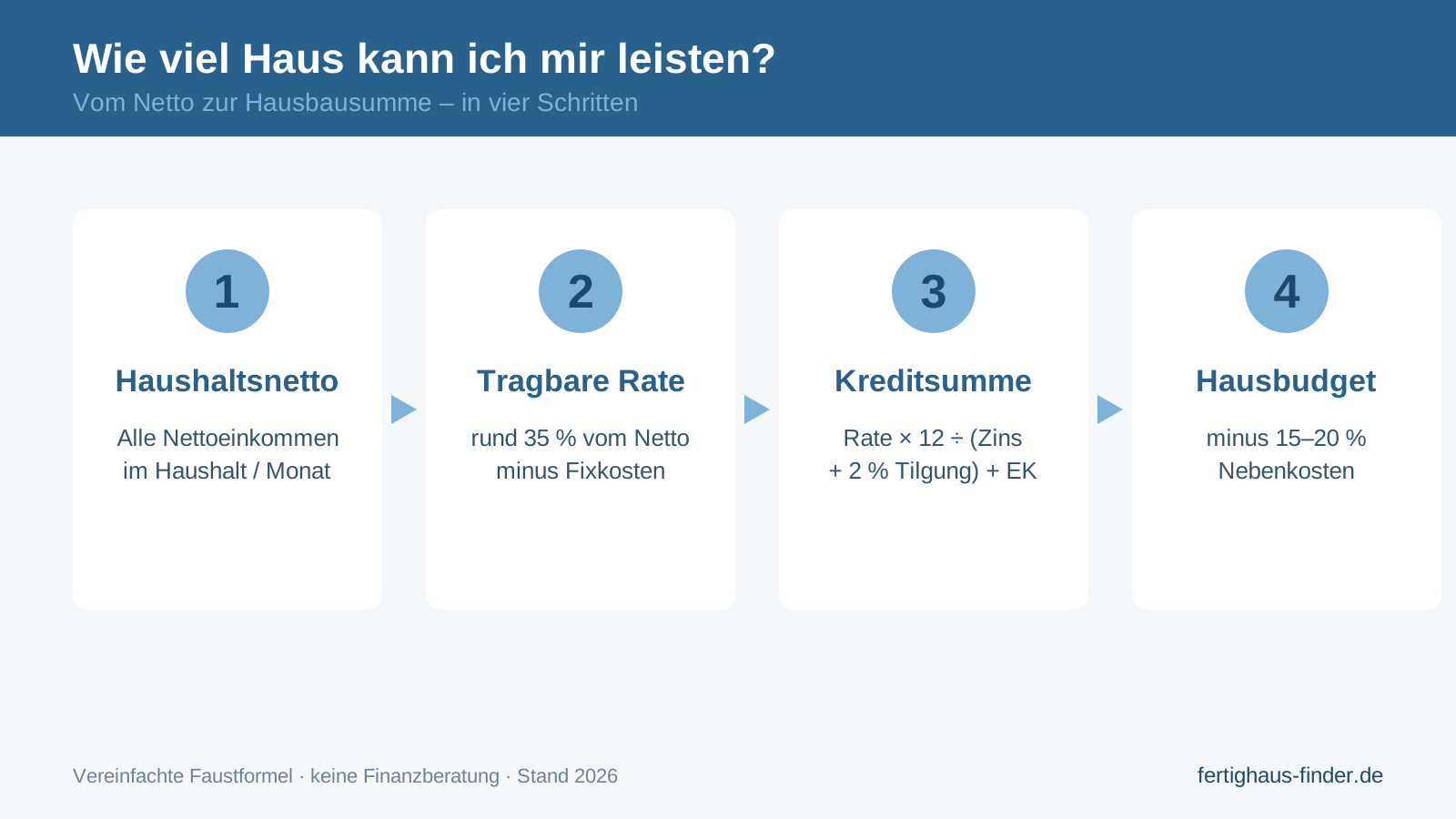
How much house can I afford?
Short answer: As a rough guide your credit rate should not exceed around 35 % of the household net income. At 3,500 € net this is about 1,225 € rate, from which at 4 % interest and 2 % repayment a loan of around 245,000 € results. With 40,000 € equity and after deduction of 15–20 % ancillary costs a realistic house budget of about 220,000 to 260,000 € remains. Calculate your personal range below in the budget calculator.
Many prospective builders first look at houses and then at the budget – the reverse is more sensible. If you know which monthly rate is affordable the loan amount and thus the overall budget can be derived from it. It is important that the house price does not correspond to the overall budget: purchase and construction ancillary costs of typically 15 to 20 percent are deducted first. The calculator takes care of exactly this calculation for you.
Budget calculator: your personal house budget in seconds
Enter your monthly household net income, your equity and your fixed costs and set the interest. The calculator shows live the maximum affordable rate, the possible loan sum, your overall budget and – after deduction of the ancillary costs – how much is really left for the house.
Budget calculator: How much house can you afford?
Simplified rule of thumb and non-binding orientation – no financial advice. The affordable loan additionally depends on creditworthiness, term, account management and individual life situation. Binding figures are only provided by a personal financing conversation (Stand 2026).
What rule of thumb is behind the budget?
The calculation is deliberately kept simple so that you can follow it yourself at any time. In six steps you go from income to the realistic house budget:
- Realistically record household net income: add up all regular net incomes, but no uncertain special payments.
- Deduct fixed costs and existing loans – only the rest is available for the house rate.
- Determine maximum rate: as orientation around 35 percent of the net minus the fixed costs.
- Derive loan sum: rate × 12 divided by interest plus 2 percent initial repayment.
- Add equity and form the total budget from it.
- Deduct 15 to 20 percent construction ancillary costs – only then do you know the real house budget.
An example: 3.500 € net result in 1.225 € affordable rate. At 4 % interest and 2 % repayment (together 6 %) this corresponds to a loan of around 245.000 € (1.225 € × 12 ÷ 0,06). With 40.000 € equity the total budget is about 285.000 €. After deduction of 15 to 20 percent ancillary costs around 228.000 to 242.000 € remain for the house.
Net income and realistic house budget at a glance
The table shows the rule of thumb for common incomes – with maximum rate, loan framework and realistic house budget. The values are based on 4 % interest, 2 % initial repayment and an equity of around 20 % of the total budget.
Reference values according to the 35-% rule of thumb – simplified, no financial advice (Stand 2026).
| Household net income/month | Max. rate (35 %) | Loan framework* | Realistic house budget** |
|---|---|---|---|
| 2.500 € | 875 € | 175.000 € | 155.000 – 186.000 € |
| 3.000 € | 1.050 € | 210.000 € | 187.000 – 223.000 € |
| 3.500 € | 1.225 € | 245.000 € | 218.000 – 260.000 € |
| 4.000 € | 1.400 € | 280.000 € | 249.000 – 298.000 € |
| 5.000 € | 1.750 € | 350.000 € | 311.000 – 372.000 € |
*Loan framework without fixed costs deduction, at 4 % interest and 2 % repayment. **House budget after deduction of 15–20 % construction ancillary costs, including around 20 % equity. For the suitable offers per budget helps the Detailed comparison by income.
What role does equity play?
Equity is the second major lever besides income. It lowers the required loan sum and often improves the interest rate because the bank carries a lower risk. As a guide: The purchase and construction ancillary costs – i.e. the 15 to 20 percent that are deducted in the calculator – should be covered as completely as possible from equity. This way the bank finances only the pure house construction and the monthly rate remains lower. Every additionally contributed euro of equity enlarges the budget that is really available for the house.
Equity includes not only savings and securities but also already available building land, building society savings as well as in limited scope the so-called muscle mortgage – i.e. own performance in self-finishing. It is important not to put an emergency reserve into the house: A financial cushion for repairs, job change or unexpected expenses should remain even after the house construction.
Why the total budget is not the house price
A common planning error: The calculated total budget is fully planned as house price. In fact purchase and construction ancillary costs are first deducted from it. These include the real estate transfer tax, notary and land registry costs, building permit, surveying, development and house connections, floor slab or basement, external installations as well as construction power and insurances during the construction phase. In sum these items typically reach 15 to 20 percent – with smaller building projects or difficult building plots even more.
Therefore the calculator does not show the total budget as house price but deducts the ancillary costs and shows the range really available for the house. Calculate the building plot additionally and regionally separately – the prices differ significantly depending on location. A detailed breakdown of your individual costs is provided by the construction financing calculator.
How high should the rate be at maximum?
The 35 percent limit is an upper limit, not a goal. In addition to the loan rate living expenses, maintenance, reserves and unforeseen must be covered. Families with children or households with further loans should set the limit significantly lower – therefore the calculator deducts your fixed costs separately.
If you have a specific price class in view, you will find suitable offers under prefabricated house up to 200.000 € or prefabricated house up to 250.000 €. A complete overview offers the page prefabricated houses by budget, and the exact rate you calculate in the construction financing calculator.
Tools for builder-owners
If the budget is clarified, implementation is next. Structure is provided by the house construction checklists. A common thread across all construction phases is provided by the free house construction course. Those who want to reduce costs check the own contribution in house construction. Rights, obligations and further assistance are bundled on the page For builder-owners: Rights, obligations & tools.
Find suitable houses matching your budget
You now know your realistic house budget – now we find the suitable houses. A few short questions regarding size, fit-out stage and region are sufficient and we match with 140 providers and send you free suitable offers within the budget.
